How to Buy Land and Build a House in Tennessee, Step by Step
To buy land and build a house in Tennessee, work in this order. Talk to a lender, pick the area, and find the lot. Make an offer with a due diligence contingency, and check zoning, utilities, flood maps, access, and title before you close. Then design, permit, and build. The order matters more than the speed, because the mistake it prevents is an expensive one: closing on land before anyone has confirmed what it allows.
What order should you do things in?
Buying land to build a house in Tennessee follows the same basic path whether the lot is two acres in Williamson County or a fifty-foot infill lot in Nashville. The steps overlap a little, but skipping ahead is where money gets lost.
Talk to a lender about the land and the build together, so you know what you can carry.
Choose the area, and learn which government reviews building there.
Find lots: raw land, a vacant infill lot, or a house worth less than the ground under it.
Make an offer with a due diligence contingency and a closing date that leaves you room.
Run due diligence: zoning, utilities, sewer or septic, flood maps, access, title, and a builder's site read.
Close, with a survey in hand and owner's title insurance considered.
Design the home to the lot, then engineer it.
Submit for permits, including a demolition permit if there is a house to remove.
Break ground.
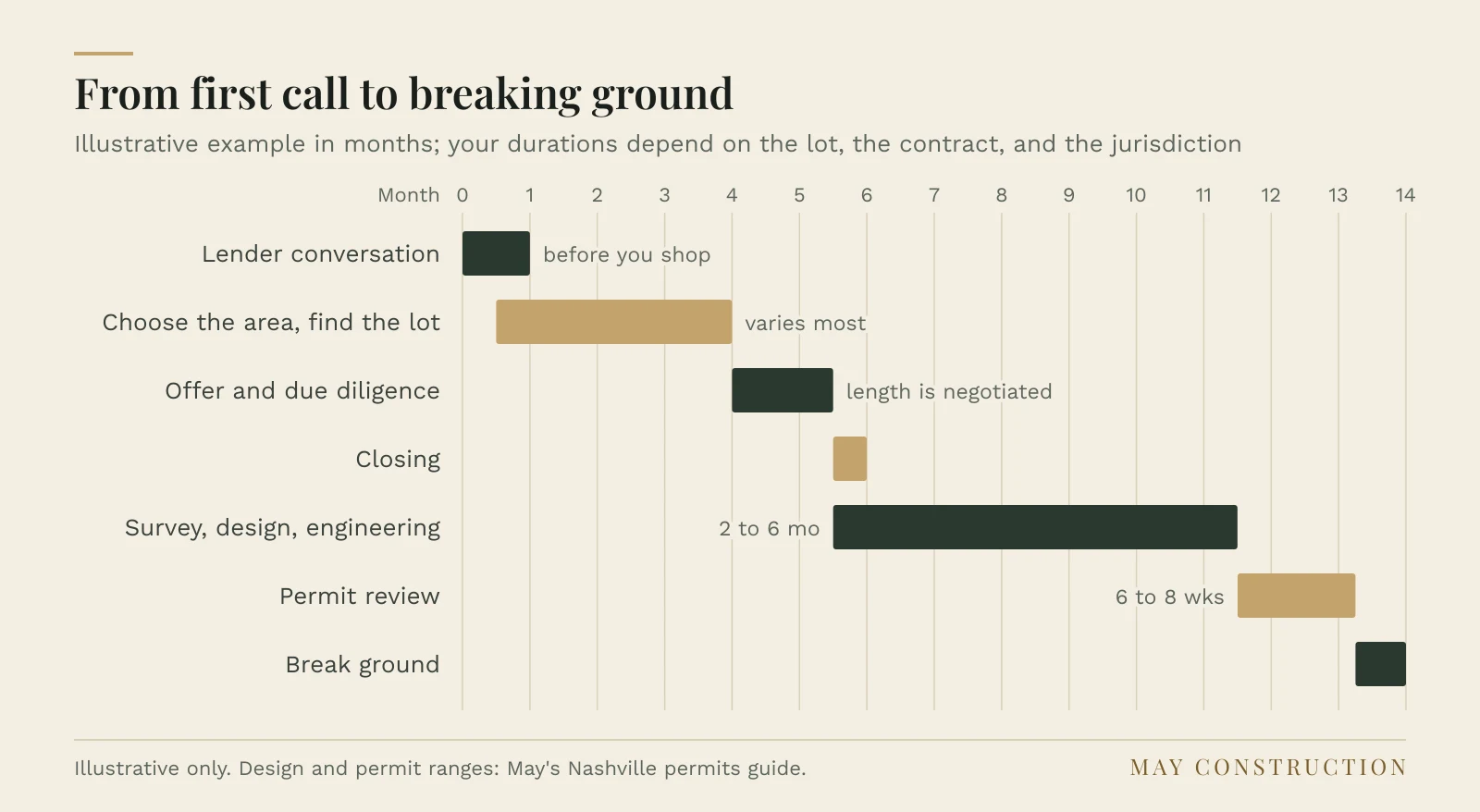
The chart below shows how those stages can stack up. The land months are an example, not a promise; lot searches can take a week or a year. The design and permit ranges come from our Nashville building permits guide, which puts design and engineering at two to six months and permit review at about six to eight weeks once a complete set is submitted.
How do you pay for land and a house together?
Start with the money, because it decides how you write the offer. Paying cash for a lot and financing the house later is one path. Another is a single-closing construction-to-permanent loan, and Fannie Mae's guidelines for that kind of loan cover both starting points:
If you don't own the lot yet, the loan can buy it and fund construction.
If you already hold title to the lot, you can refinance it into the construction loan.
Lenders set their own terms on top of that, so the details vary from bank to bank.
What to ask a lender in that first conversation: whether they will finance the lot, what they need to see on the lot before closing, and whether they require plans and a builder contract before the construction loan closes. We walk through draws, appraisals, and loan types in our guide to construction loans in Tennessee.
This is general information, not financial or legal advice. A lender can tell you what you qualify for, and a Tennessee real estate attorney can review a land contract before you sign it.
Where should you look for land in Nashville and Williamson County?
Pick the area before the lot, and learn who governs it. In Davidson County, zoning and permits run through Metro Nashville. Small cities like Forest Hills and Oak Hill sit inside the county with their own rules. South of the county line, Brentwood and Franklin each run their own planning and codes offices, and unincorporated land falls under Williamson County Planning and Zoning. The same house can meet different setbacks, fees, and review times a few miles apart.
The kind of lot follows the area. Close-in Nashville neighborhoods rarely have empty land, so most buildable lots there hold an older house. Brentwood and Franklin offer more acreage and more lots in established subdivisions, where HOA covenants can add their own rules on top of zoning. Our comparison of building in Brentwood versus Franklin covers how those two differ day to day.
Is a teardown lot a good way to build in Nashville?
Often, yes. In neighborhoods like Green Hills, most buyers trade an older ranch or Cape Cod for a new house on the same footprint, and the utilities are already at the street. A teardown is a normal start for us, and we handle the demolition as part of the build. But a teardown lot carries a second set of questions, and they belong in due diligence, not after closing.
The demolition permit
Removing a house takes its own permit. Metro Codes lists demolishing "any structure or portion thereof" among the work that requires a building permit. So a teardown lot usually needs at least two permits: one to take the old house down and one to build the new one. Metro Public Health's Pollution Control Division is the asbestos enforcement agency for Davidson County, so ask early whether the old house needs an asbestos survey before demolition. You can also look up past permits on any address through Metro's property permit history search.
Historic and conservation overlays
This is the check that can stop a teardown outright. Parts of Nashville sit inside historic preservation or neighborhood conservation overlays, and the Metro Historic Zoning Commission reviews new construction, additions, and demolition inside them. Its handbook sets out the rules a teardown buyer needs to know:
Inside either overlay type, tearing a house down in whole or in part needs a preservation permit, and that permit comes before the building permit.
To demolish a historic building, the owner has to prove hardship, and hardship is judged on the property, not the owner's finances.
Outside the overlays, the commission can put a 90-day delay on demolishing a building that is listed or eligible for the National Register.
It also reviews demolition requests for any building built before 1865.
Check the overlay district boundaries before you make an offer on a house you plan to remove.
How should you write the offer?
Write the offer so you can walk away if the lot fails a check. That means a due diligence contingency, sometimes called an inspection or feasibility period, that lets you cancel for anything you find during a set number of days. The length is negotiable. A short window saves the seller time, but a lot that needs a septic evaluation or a sewer answer from the utility may need longer.
Other terms worth talking through with your agent and attorney:
A financing contingency, if the lot purchase depends on a loan.
Who pays for the survey, and whether the offer depends on a survey you accept.
A closing date that leaves room for the lender's appraisal and any utility or septic answers.
For a teardown, whether the house is occupied and when it will be empty.
The single most useful thing to do before you sign: get a builder's read on the lot before you go under contract. We walk lots at exactly that stage. An hour on site with a builder usually answers more than a week of looking at listing photos, including whether the home you want fits the ground at all.
What should you check before buying land?
Use the due diligence window to answer every question in this table. Each one has an official place to look it up, and most are free. If you already own a lot, our feasibility guide goes deeper into setbacks, grade, and trees once the land is yours.
| Item | What to check | Where to check it |
|---|---|---|
| Zoning and setbacks | The zoning district, overlays, and how much of the lot you can build on | Metro Nashville Parcel Viewer; Williamson County, Franklin, or Brentwood planning offices |
| Historic or conservation overlay | Whether demolition or new construction needs a preservation permit | Metro Historic Zoning Commission district maps |
| Water and sewer | Whether public lines reach the lot and have capacity, or need an extension | Metro Water Services development permits (Davidson County) |
| Septic, if no sewer | Whether the soil will support a septic system and where it can go | TDEC septic permits; Williamson County Sewage Disposal Management |
| Flood zone | Whether any part of the lot sits in a mapped flood hazard area | FEMA Flood Map Service Center |
| Access | Frontage on a public road or a recorded easement to one | Your survey and title search |
| Title | Liens, easements, covenants, and whether the seller can convey clean title | Title company or Tennessee real estate attorney |
| Permit history | Open permits or past work on the property | Metro property permit history |
| Local fees | Fees due at permit, such as Williamson County's educational impact fee on new homes | The county or city office that issues the permit |
A few notes on the sources. Metro's Parcel Viewer shows the zoning and parcel lines for any Davidson County address, and Metro Codes keeps a contact list for due diligence questions. For water and sewer, Metro Water Services decides whether there is capacity for a new connection. Its single-family development guide shows the availability and capacity steps. A lot without lines at the street may need a public extension project first. Start with the water and sewer permits page to ask.
Off sewer, a septic system needs a permit before it is built, and a state environmental scientist evaluates the site to decide what kind of system it needs. TDEC's septic permit program says a construction permit review generally takes about 10 days and must be completed within 45 days of a complete application. In Williamson County, onsite systems run through the county's Department of Sewage Disposal Management. Check the FEMA Flood Map Service Center for every address, including ones nowhere near a creek.
Fees differ by place, too. Williamson County charges an educational impact fee on new residential building permits, and cities like Franklin and Brentwood run their own planning and codes offices. Ask the office that will issue your permit for the current schedule before you set a budget.
Can you build on family land in Tennessee?
Usually, but the land has to become a legal lot in your name first. Four things decide it: the deed, the lot, the access, and the title.
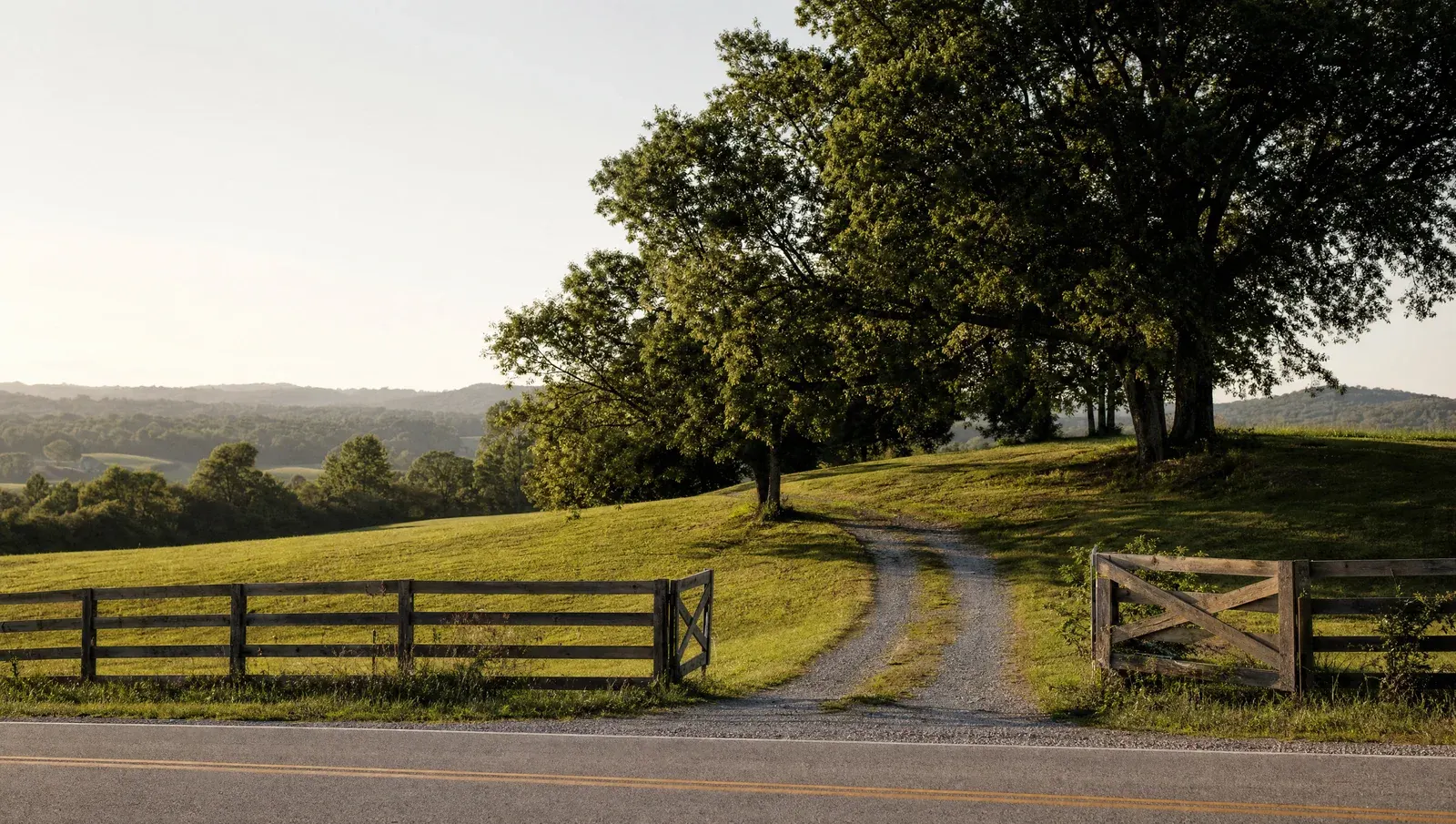
The deed. You generally need title to the ground you build on, and a lender will want it too. If a parent or grandparent still owns the land, a deed has to move the piece you will build on into your name.
The lot split. Carving a house site out of a larger tract is a subdivision. In Davidson County, Metro's subdivision regulations define a subdivision as dividing land into two or more lots or parcels under five acres, and a simple split into two lots on an existing street can be handled as a partition. Unincorporated Williamson County has its own subdivision regulations.
Access. The new lot needs frontage on a road or a recorded easement across family land. An easement everyone agrees on today should still be written down and recorded.
Title. Heirs, old liens, and informal family arrangements all show up in a title search. Settle them before you borrow against the land.
Family land can save the cost of a lot, but it is not free. Survey, plat, legal, and utility work all come first. A Tennessee real estate attorney should handle the deed and the split. And if the family decides the land is better sold than built on, selling the lot to a builder is an option some owners in Nashville's established neighborhoods take.
What happens between closing and breaking ground?
Closing on the lot starts the design clock. A topographical survey comes first, because Native, our in-house design studio, draws the plan, interiors, and landscape from it as one package. Plans go through review rounds, then structural and civil engineering, then permits. Every May build files the permit package alongside four utility applications. The full sequence is on our process page, and our custom home timeline guide explains why we give that sequence instead of a single date.
The lot keeps shaping the work. Our Westboro home sits on a sloped corner in Charlotte Park, and the build uses a stone retaining wall to hold the lawn above the drive court. Grade like that is something you want to know about during due diligence, because it moves site work and engineering. Before you sign with any builder, verify the license through the Tennessee Board for Licensing Contractors.
Is it cheaper to buy land and build than to buy a house?
Sometimes, but not by default. Building lets you choose the lot and the plan, and the lot price is only one line of the budget. Site work, utilities, demolition, and design all come before the first wall goes up. Two lots on the same street can carry different budgets for the same house. Our custom home cost guide breaks down what moves the number, with the ranges we publish by neighborhood.
The fairest comparison is the finished home you want, on the street you want, against what similar homes sell for there. Get the lot read and a real budget before you decide, and protect yourself with owner's title insurance at closing; the CFPB explains what that policy covers and that you can shop for it.
Questions, answered
- Can I buy land and just build a house on it?
- Only if the land is a legal lot that zoning allows a house on, with road access and a way to handle water and sewage. You also need a building permit from the city or county before any work starts. Checking those things before you close is the point of a due diligence period.
- Is $200,000 enough to build a house in Nashville?
- Not for the kind of custom home we build. Across the neighborhoods we serve, custom homes typically start around $1.2 million for Franklin infill and rise from there. Other builders and home types will have different ranges, so ask any builder what their number includes.
- How long is a due diligence period on land?
- There is no fixed length; it is whatever the contract says, and it is negotiable. Build in enough time for the checks the lot actually needs. A septic evaluation or a sewer capacity answer from the utility can take longer than a zoning lookup.
- Do I need a survey before buying land?
- It is strongly worth having one. A boundary survey shows the real lines, easements, and encroachments, and design needs a topographical survey anyway. Your lender or title company may require a survey before closing, so ask early.
- Can I tear down a house in a Nashville historic district?
- Only with approval. Inside historic preservation and neighborhood conservation overlays, demolition needs a preservation permit from the Metro Historic Zoning Commission before a building permit, and demolishing a historic building requires the owner to prove hardship. Check the overlay maps before you make an offer.
- Can May help me find a lot?
- Yes. We acquire lots across Nashville's established neighborhoods and can pair you with one, or walk a lot you are considering before you go under contract. Tell us where you want to live and we will tell you what we know about it.