Construction Loans in Tennessee: How They Work for a Custom Home
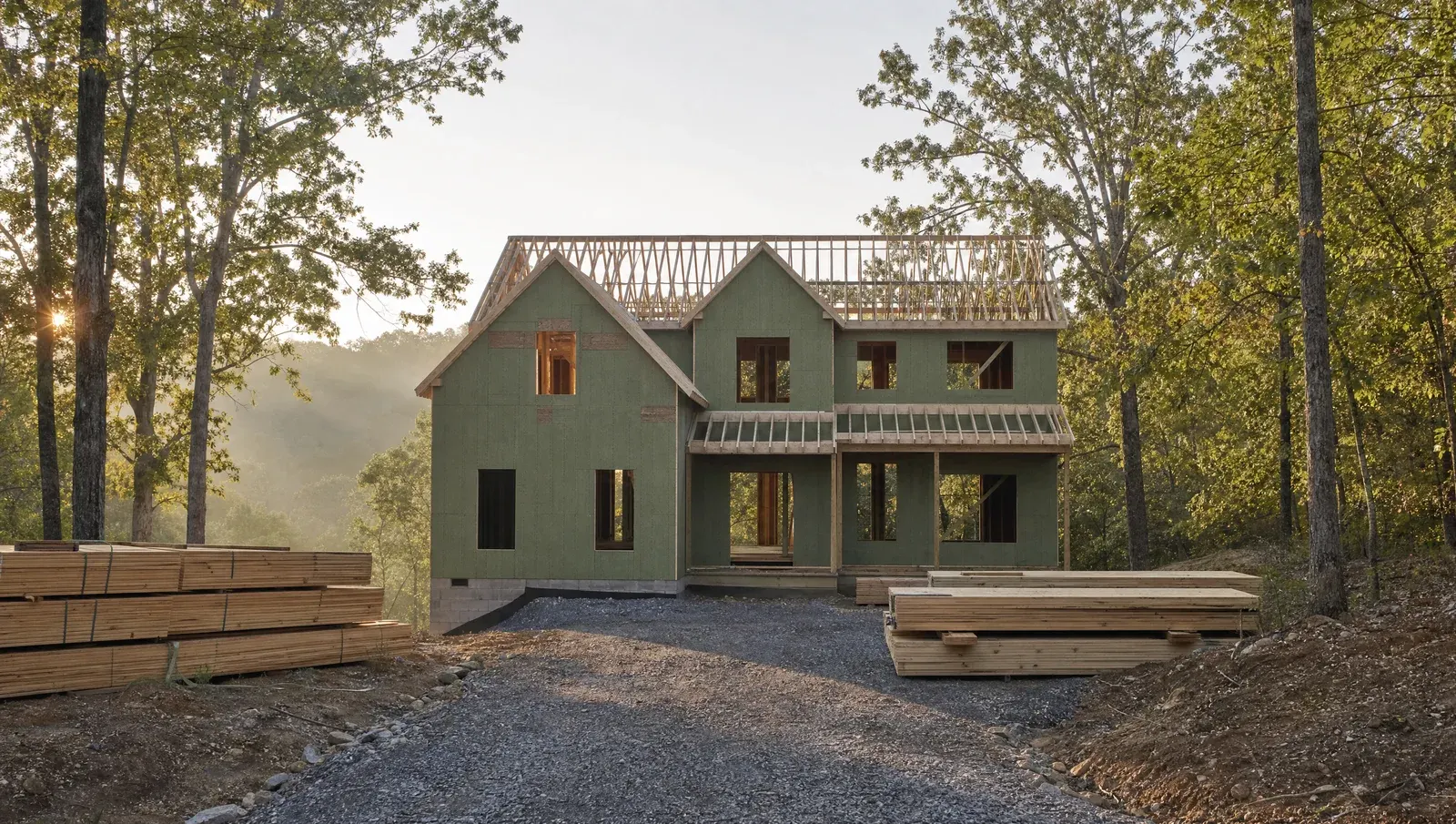
A construction loan in Tennessee pays for a custom home in stages while it is being built, not in one lump sum at closing. Most owners use a one-time-close construction-to-permanent loan, which becomes an ordinary mortgage when the house is finished, or a two-time close, where a short construction loan is paid off by a separate mortgage. During the build you usually pay interest only on the money drawn so far, the lender checks the work before each draw, and the loan is sized against what the finished home will be worth.
How does a construction loan work?
The Consumer Financial Protection Bureau describes a construction loan as usually a short-term loan that provides funds to cover the cost of building or rehabilitating a home, with the money advanced in a series of payments as construction moves along. It notes these loans carry higher interest rates than longer-term mortgages, and that at the end you either pay off the balance or convert it to a regular mortgage. If your loan does not convert automatically, you may have to apply again.
Compared with buying a finished house, the mechanics change. The lender is lending against something that does not exist yet. The money goes out in pieces, each one tied to work on the ground. And your payment during the build is usually interest on what has been drawn, not a full principal-and-interest mortgage payment.
The sequence looks like this: you get approved, you close (once or twice, depending on the loan), the builder completes a phase, an inspector confirms it, the lender releases that draw, and the cycle repeats until the house is done. At the end, the loan either converts to your permanent mortgage or gets paid off by one.
Which type of construction loan fits your project?
Four structures cover most custom homes, and two federal programs, FHA and VA, offer their own versions. The first four rows describe general loan structures; the FHA and VA rows come from each agency's own guidance, linked below the table.
| Loan type | Closings | How it works | Worth knowing |
|---|---|---|---|
| One-time close construction-to-permanent | One | One loan funds the build in draws, then converts to your long-term mortgage when the home is complete. | Fannie Mae caps the construction period at 12 months per period and 18 months total. |
| Two-time close | Two | A short construction loan funds the build; a separate mortgage pays it off at the end. | You qualify twice, and pay closing costs twice. The second loan's terms are set at the end. |
| Standalone construction loan | One, for the build only | Short-term loan for the build, repaid in a lump sum or by whatever financing you arrange later. | Fits owners who plan to pay off the balance from a sale or cash, not a new mortgage. |
| Lot or land loan | Separate | Finances the land purchase before you are ready to build. | Terms vary by lender. Ask whether your construction loan can pay it off at closing. |
| FHA one-time close | One | HUD's construction-to-permanent program, a single closing before construction starts. | Builder must be a licensed general contractor. Subject to FHA county loan limits. |
| VA construction loan | Per lender | A VA-backed loan used to build, through a lender that offers a construction product. | May need no down payment. You approve each draw in writing. |
Sources for the table: Fannie Mae's single-closing rules and its overview of single and two-closing transactions; HUD Handbook 4000.1 (the FHA construction-to-permanent section); and VA's guidance on construction loans.
A note on the government programs at luxury price points. HUD set the 2026 ceiling for a one-unit FHA loan at $1,249,125 in the highest-cost areas, and many counties sit below it. The custom homes we build in Brentwood typically run $1.5M to $4M, so most owners building at that price point look at conventional or portfolio construction loans. FHA and VA are still worth raising with a lender if they fit your budget.
What do lenders review before approving a construction loan?
Two files get underwritten: yours and the project's. On your side it looks like any mortgage application. VA's guidance, for example, says to expect proof of income, reserves, assets and debts, plus a full credit check, and calls construction lending stricter and more document-heavy than a standard purchase.
On the project side, expect the lender to ask for:
Plans and specifications complete enough for an appraiser to value the finished home.
A signed contract with your builder that states the price to build. HUD requires one for FHA construction-to-permanent loans.
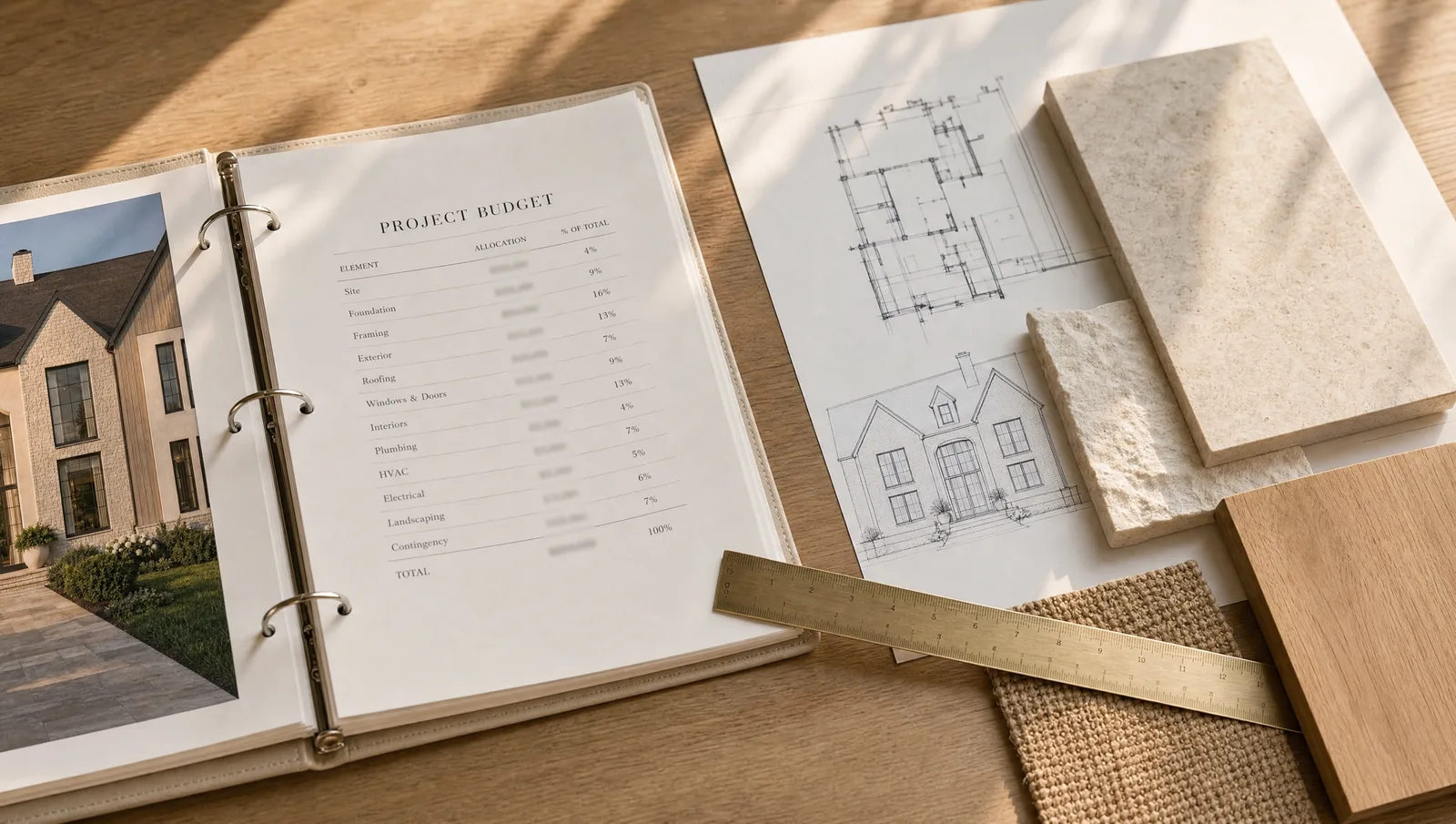
A cost breakdown or budget, including any options you are paying for outside the contract.
Proof of land ownership, or the purchase contract if the lot is being bought at closing.
Builder information, including the builder's license. Tennessee licenses contractors through the Board for Licensing Contractors, which runs a public lookup.
The appraisal is the piece most people have not seen before. For a construction loan, the appraiser values the home "as completed," working from the plans and specs. Under Fannie Mae's rules, the loan-to-value on a purchase is measured against the lower of the total cost (construction plus the lot) or that as-completed value. When the home is finished, the appraiser confirms completion, and if the value has dropped, the lender has to order a new appraisal and qualify you again.
This is where a complete plan set earns its keep. A thin set of drawings forces the appraiser to guess, and a guess rarely works in your favor. Before a home is priced, our design studio resolves the plans, interiors and landscape together, so the drawings describe the house that will actually be built.
How draws and inspections work during the build
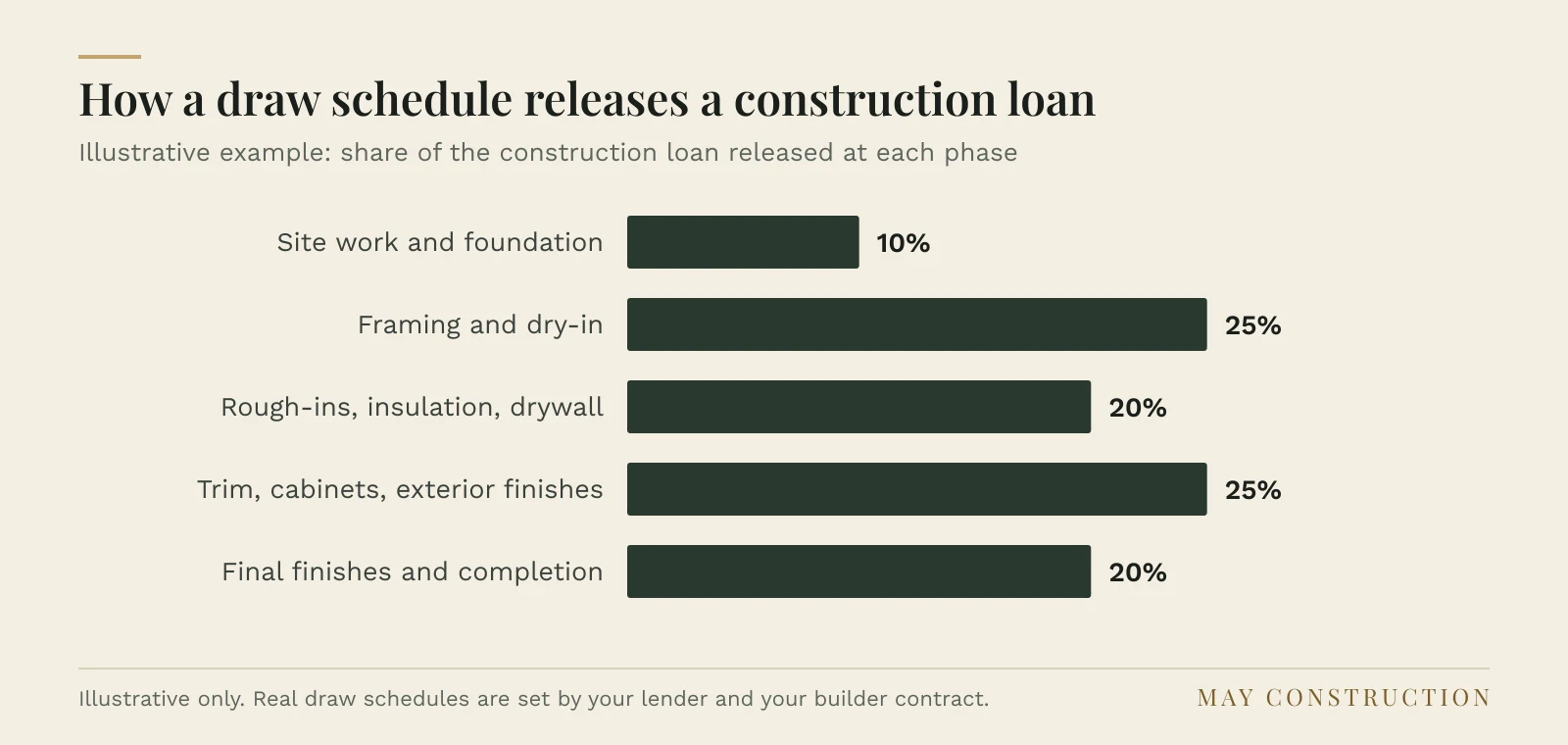
Each draw follows the same loop. The builder finishes a stage, requests payment, an inspector visits and confirms the work, and the lender releases the money. The federal programs spell out your role. Under HUD's FHA rules, the loan balance left after any land purchase goes into an escrow account paid out as construction progresses, and the lender must get your written authorization for each draw. VA's guidance says the same about written approval before each payment to the builder.
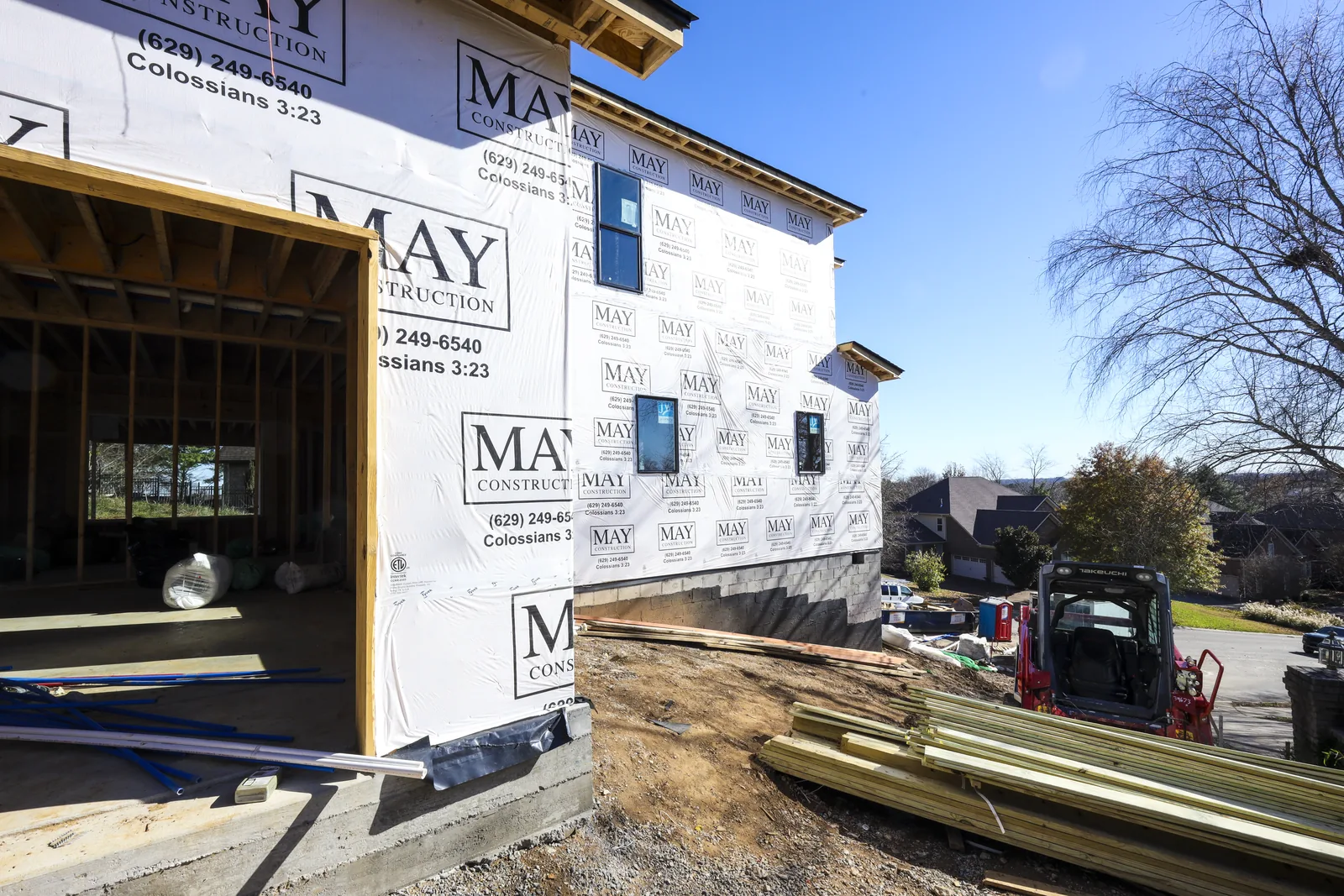
Inspections measure progress against the budget line for that stage. A draw inspector's report reads like a progress log: what share of framing, roofing or trim is in place. Our own logs look like that too. By April 2026, the progress log for 123 Glen Leven Way recorded the exterior brick fully complete, interior trim about ninety percent along, and cabinets installed.
Time matters as much as money. Fannie Mae's single-closing loans allow no single construction period over 12 months and no more than 18 months in total, and FHA amortization has to start within about two months of the final inspection or certificate of occupancy. That is why the schedule you agree with your builder should fit inside the loan's clock. Our guide to how long a custom home build takes in Nashville breaks down the phases, and the permits guide covers the review time that comes before the first draw.
Why interest during construction starts small and grows
Interest is charged on the amount drawn, not the full loan. Early in the build, when only the foundation has been paid for, the interest bill is small. It climbs with every draw and peaks right before the loan converts.
Here is the math on an illustrative $1.2M construction loan, using a hypothetical 8% rate chosen because it divides cleanly. It is an example, not a rate quote. The monthly interest is the drawn balance times 8%, divided by 12. With 5% drawn, that is $60,000 times 0.08 divided by 12, or $400. Fully drawn, it is $1,200,000 times 0.08 divided by 12, or $8,000.
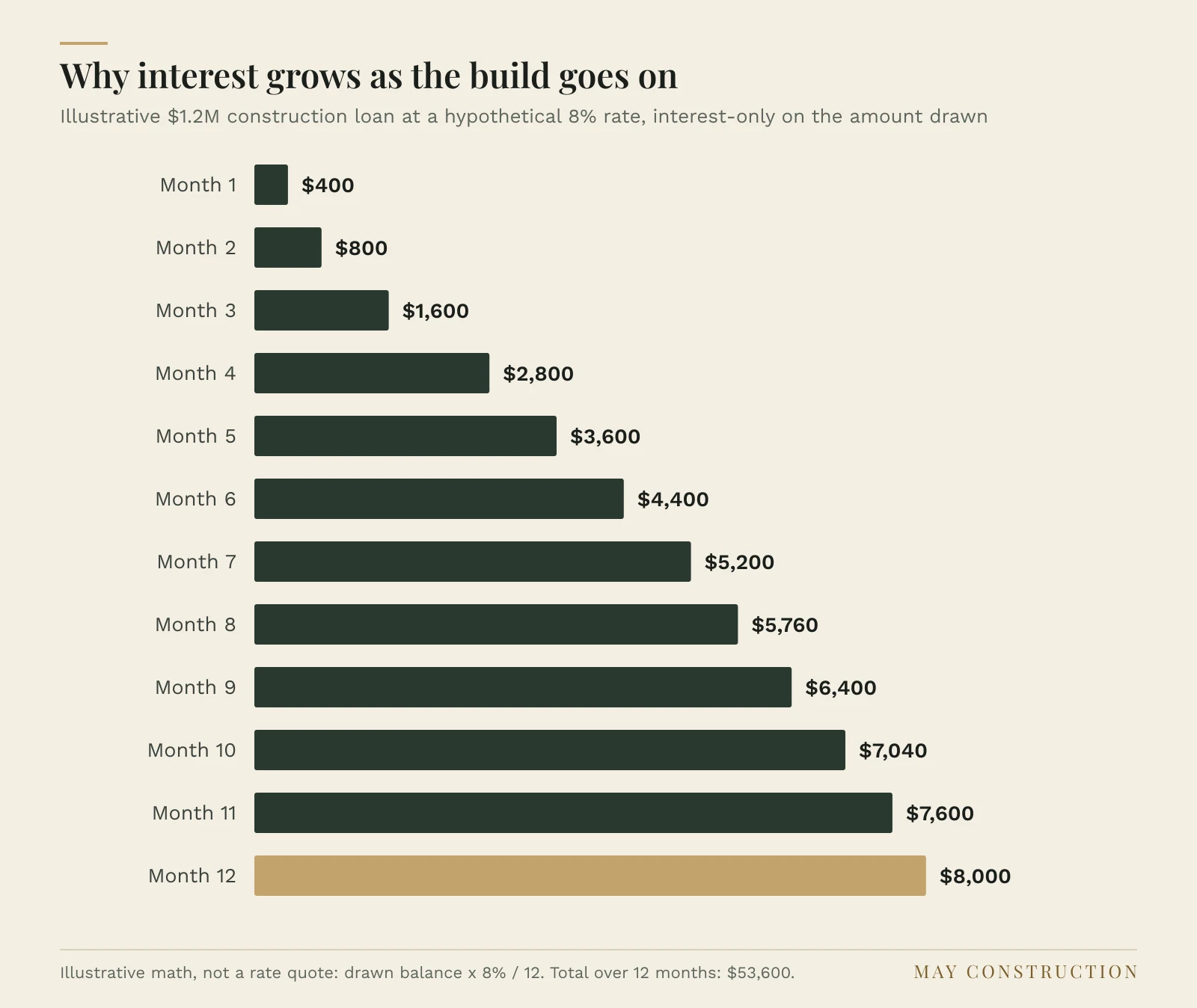
Across the 12 months in the chart, interest totals $53,600. Had the whole $1.2M been advanced on day one, it would have been $96,000. Federal disclosure rules make a similar simplification: when estimating construction interest, lenders may assume half the loan is outstanding for the whole construction period. In the example, the average balance works out to about 56%. Ask your lender for this estimate on your own draw schedule, and plan your cash flow around the last few months, not the first.
Then the payment changes shape. Once the loan converts, or the permanent mortgage pays it off, you pay principal and interest on the full balance at the permanent rate and term in your loan documents, and that rate may differ from the construction rate. Staying with the same hypothetical numbers, a fully drawn $1.2M on a 30-year schedule at 8% works out to about $8,805 a month, higher than the $8,000 interest-only figure because principal is now part of every payment. Treat that as an illustration of the shift, not a forecast; the disclosures your lender gives you show the real figure.
Can land equity count toward the down payment?
In many cases it can. If you own your lot, its value can do much of the work a cash down payment would. The detail depends on the program.
Fannie Mae treats a single-closing loan on a lot you already own as a limited cash-out refinance, with the loan-to-value measured against the as-completed value of the lot and the home together (Fannie Mae).
FHA lets land equity satisfy the minimum required investment, which is at least 3.5% of the adjusted value. Land owned more than six months counts at its appraised value; newer land counts at the lesser of cost or appraised value (HUD Handbook 4000.1).
Take a lot bought years ago that has gained value. Under rules like these, the lender may count what the land is worth today, not what you paid. How each lender values land, and whether it wants an appraisal of the lot alone, is worth pinning down early. A read on the lot before you apply helps too, because the lot's constraints shape the plans the appraiser will value.
If you are still shopping for land, our guide to buying land and building a house in Tennessee covers the purchase side, and the lot feasibility guide covers what setbacks, grade and utilities do to a budget. If you already own the lot, our build-on-your-lot page explains how we read a site before anything is drawn.

What does the builder give the lender?
More than most owners expect. The lender is betting on the builder finishing the house for the price in the contract, so the builder's side of the file gets real scrutiny. The list varies by lender, but it commonly covers the license, the signed contract and price, the plans and specifications, a line-item budget, the draw schedule, and proof of insurance. Draw requests then come with an invoice or progress report at each stage.
A lender wants a number that will hold, and that depends on how the builder prices the job. At May, the approved plan is bid to our trade partners and every bid is checked against an independent takeoff; the budget locks before a single purchase order goes out. The full sequence is on our process page. Your contract type changes the lender's view too, which is why our comparison of cost-plus and fixed-price contracts is worth reading before you apply. For what drives the number itself, see what a custom home costs in Nashville.
If you are lining up financing now, start a conversation with our team about your project and the list your lender has handed you.
What Tennessee's mechanics' lien law means for your loan
Tennessee gives a lien on the property to contractors who improve it and who have complied with the state's contractor licensing law, and that lien secures the contract price (Tenn. Code § 66-11-102). Other sections of the same chapter set notice rules and treat owner-occupied homes differently from other property.
Why a borrower should care: a lien that attaches to your lot also attaches to the lender's collateral. That is why the paperwork around each draw exists. Fannie Mae will not buy a finished construction-to-permanent loan until the work is paid for and every mechanic's and materialman's lien is satisfied, and HUD requires a title update after conversion showing the property is free of other liens. Lenders commonly ask for lien waivers from the builder, and sometimes from major trades, before releasing a draw.
The details (who can file, the deadlines, what notices apply to an owner-occupied home) are a legal question. A Tennessee real estate attorney can walk you through them for your contract.
Questions to ask a lender before you apply
Bring this list to each lender you talk to, and compare the answers side by side:
Do you offer a one-time close, a two-time close, or both, and which do you suggest for a custom build on my lot?
How long is the construction period, and what happens if the build runs past it?
Is my rate locked at closing, or does it float during construction? If it floats, is there a cap?
How do you value land I already own, and how much of that equity counts toward my down payment?
What does your appraiser need from my builder to value the home as completed?
How many draws are allowed, who inspects, and how quickly is a draw funded after inspection?
Do you require lien waivers with each draw, and from whom?
What contingency or reserve do you require for cost overruns, and who controls it?
What will my interest-only payments look like on my draw schedule, month by month?
What has to be complete, and what paperwork do you need, before the loan converts or is refinanced?
Your builder belongs in this conversation too: how have they handled construction draws before, and how do they document each one? Our guide to choosing a custom home builder in Nashville has more questions for that side of the table.
This guide is general information, not financial or legal advice. For your own loan, talk with a licensed mortgage lender, and for lien or contract questions, a Tennessee real estate attorney.
Questions, answered
- Is it hard to qualify for a construction loan?
- It is usually harder than qualifying for a mortgage on an existing house, because the lender is also underwriting a home that is not built yet. Your income, assets and credit get the same review as any mortgage, and then the house itself is reviewed: the plans, the budget, the builder and an appraisal of the finished value. Even VA, whose program may need no down payment at all, warns veterans to expect tougher qualifying and more paperwork.
- Do I need 20% down for a construction loan?
- Not always. The required down payment depends on the program and the lender: FHA's minimum investment is 3.5% of the adjusted value, and VA says its construction loans may need no down payment. Conventional and portfolio lenders set their own limits. If you own your lot, its equity can often count toward what you put in.
- What is the monthly payment on a $200,000 construction loan?
- During the build it is usually interest only on the amount drawn. At a hypothetical 8% rate, used here only to show the math, a fully drawn $200,000 costs about $1,333 a month in interest, and half drawn about $667. After conversion, the payment becomes a regular mortgage payment based on your permanent rate and term.
- Can I use the land I already own as my down payment?
- Frequently, though the rules differ by program. On a conventional loan sold to Fannie Mae, a lot you own is valued as part of the finished property rather than at what you paid for it, and FHA accepts land equity in place of cash for its 3.5% minimum. How long you have held the land can change the figure: FHA counts land owned over six months at its appraised value.
- How long does a construction loan last?
- The construction phase is short. For loans sold to Fannie Mae, it can run no longer than 18 months in total, with no single period over a year. After that the loan becomes (or is replaced by) a long-term mortgage that runs on its own schedule. Before you sign, find out what an extension costs and whether a late finish would mean qualifying again.
- Can I act as my own general contractor on a construction loan?
- Usually not, unless you are licensed. HUD's FHA program lets a borrower act as the general contractor only if the borrower is a licensed general contractor, so expect a lender to ask for a licensed builder on the contract. In Tennessee you can check any builder's license through the Board for Licensing Contractors.